
EEOC Criminal Background Check Guidance Rescinded: What Employers Should Know Before Changing Anything
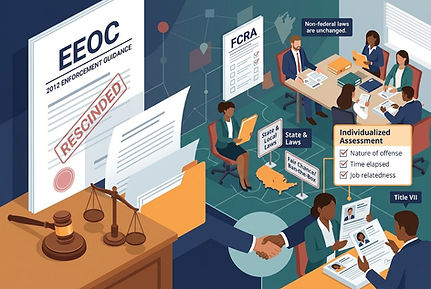
On October 28, 2026, the U.S. Equal Employment Opportunity Commission (EEOC) voted to rescind its 2012 Enforcement Guidance on the Consideration of Arrest and Conviction Records in Employment Decisions under Title VII. The agency announced the decision on October 29, and the rescission took effect immediately.
For more than a decade, that guidance shaped how many employers built their criminal background check policies. So what changes now? The short answer: less than you might think.
What happened to the EEOC criminal background check guidance
The 2012 guidance explained the EEOC's view that using arrest and conviction records could violate Title VII in two ways. The first is disparate treatment, meaning treating applicants differently based on race or national origin. The second is disparate impact, meaning a neutral policy (such as a blanket ban on anyone with a conviction) that disproportionately screens out protected groups without being job related. The guidance encouraged employers to conduct individualized assessments that weigh the nature of the offense, the time elapsed, and the nature of the job.
With the guidance withdrawn, the EEOC says it will continue enforcing Title VII's ban on intentional discrimination, including job requirements used as a stand-in for race or national origin discrimination. The agency also says the rescission does not bring back older policy statements the 2012 guidance replaced, and it does not require employers to drop lawful practices they adopted in response to it. Employment law commentators expect the agency to focus on disparate treatment rather than disparate impact cases going forward.
Keep in mind that guidance is not law. The rescission changes the EEOC's stated enforcement approach. It does not change the text of Title VII or any other statute.
Why it matters to employers
It would be easy to read this headline as "criminal background checks just got simpler." That reading could be costly, for several reasons:
Title VII still applies. Private plaintiffs can still file lawsuits, and courts, not the EEOC, decide whether disparate impact claims succeed.
The FCRA is unchanged. Disclosure and authorization forms, pre-adverse action notices, a copy of the report, the Summary of Rights, and final adverse action notices are all still required when you use a consumer report.
State and local laws are unchanged. Many fair chance and ban-the-box laws require their own individualized assessments, timing rules, and notices. New York State's Article 23-A and New York City's Fair Chance Act are prominent examples, and New York City's amended Fair Chance rules took effect just one day after the EEOC announcement.
Individualized assessment is still a sound practice. Considering the offense, how long ago it occurred, and how it relates to the job helps you make consistent, defensible decisions and widens your pool of qualified candidates.
Practical steps for employers
Do not rewrite your policy overnight. Lawful practices adopted under the 2012 guidance remain lawful, and the EEOC says it is not requiring anyone to abandon them.
Map your hiring locations. List every state and city where you hire, and confirm which fair chance laws apply. These rules now drive most of the detailed requirements.
Keep your individualized assessment process, and document it. A written, job-related rationale remains your best protection under Title VII, state law, and local law.
Review your FCRA workflow. Confirm your standalone disclosure, authorization, and two-step adverse action process are current.
Update manager training. Make sure hiring managers understand that the federal change does not loosen state, local, or FCRA requirements.
Talk with counsel before significant policy changes, especially if you hire in multiple jurisdictions.
How UBS can help
At Unique Background Solutions, compliance is built into how we work. Our team tracks federal, state, and local screening rules so you can make confident, consistent hiring decisions. If you would like a second look at your adverse action process or a review of the jurisdictions where you hire, reach out to us at www.uniquebackground.com.
Sources
This post is general information, not legal advice. Employers should consult their own legal counsel about their specific obligations.


Comments